Child Learning Style Quiz: How to Identify Your Child's Learning Style at Home
As a parent, you've probably noticed that your child lights up during certain activities but struggles with others. A storytelling session might captivate them, while building with blocks feels frustrating—or vice versa. What if you could understand why and use that knowledge to support their learning journey without formal testing?
This guide will show you how to observe your child's natural behaviors to identify whether they're a visual, auditory, or kinesthetic learner. Once you know how your child learns best, you can set up their space in ways that help them shine. We're not putting your child in a box here—this is all about uncovering what makes them special.
When you understand how your child learns, homework stops being a struggle and becomes something you can do together. You'll also have a clear roadmap to help them learn better and build confidence. For a quick and insightful starting point, you can always take our free quiz to complement your observations.

Parenting Tips for a Child Learning Style Quiz
The first step is to become a learning style detective. By paying close attention to your child’s everyday actions and preferences, you can gather valuable clues about how their brain works best. Here are some specific cues to look for, broken down by the three main learning styles: Visual, Auditory, and Kinesthetic.
Visual Learning Cues at Home
Visual learners process information best when they can see it. They often have a keen eye for detail and remember faces, places, and images more easily than names or spoken instructions.
Look for these signs:
- They are drawn to books with colorful illustrations and often stare at pictures before reading the words.
- They enjoy activities like puzzles, drawing, painting, and watching videos.
- When assembling a new toy, they insist on looking at the diagram rather than listening to you read the instructions.
- They might be tidy and organized, liking to see where everything is.
- They use phrases like "I see what you mean" or "Show me how to do it."
If you notice these behaviors, your child likely has a strong visual preference. They learn by seeing and visualizing.
Auditory Learning Indicators in Daily Activities
Auditory learners absorb information most effectively through sound. They are often great listeners and can remember spoken instructions, song lyrics, and conversations with ease.
Look for these signs:
- They love listening to stories, podcasts, or audiobooks and can retell them accurately.
- They often talk to themselves or hum while playing or completing a task.
- They are skilled at explaining ideas verbally and enjoy group discussions.
- They might be sensitive to the tone of your voice and can easily pick up on subtle changes.
- They use phrases like "I hear you" or "That sounds good to me."
For these children, hearing is understanding. Spoken words are their primary tool for learning and making sense of the world.
Kinesthetic Learning Behaviors to Watch For
Kinesthetic learners, also known as tactile learners, learn best by doing, moving, and touching. They need to physically engage with their learning material to truly understand it.
Look for these signs:
- They have a hard time sitting still for long periods and often fidget or tap their feet.
- They are naturally drawn to hands-on activities like building with LEGOs, conducting science experiments, or playing sports.
- They learn best through trial and error, preferring to jump in and try something rather than reading about it first.
- They often use hand gestures when they talk to express themselves.
- They use phrases like "I feel like..." or "Let's get a handle on this."
These children need to move to learn. Their understanding is deeply connected to physical experience and interaction.
Home Observation Strategies for Learning Style Discovery
Once you know what to look for, you can use simple, structured strategies to confirm your suspicions. These methods don't require any special tools—just a bit of time and attention. They can provide a clearer picture of your child's learning patterns.

The Daily Activity Observation Journal
One of the most effective methods is to keep a simple journal for a week. Don't overthink it; just create three columns: Activity, Child’s Reaction (Engaged/Bored/Frustrated), and Learning Style Notes (Visual/Auditory/Kinesthetic).
For example, your entry might look like this:
-
Activity: Reading a picture book together.
-
Reaction: Highly engaged, pointed at all the pictures.
-
Notes: Strong visual cues.
-
Activity: Building a model car from instructions.
-
Reaction: Frustrated trying to read text, but engaged when I explained it step-by-step.
-
Notes: Leaning toward auditory, struggled with visual-text.
After a week, review your notes. You'll likely see a pattern emerge, pointing toward a dominant learning style or a combination of styles.
Questioning Techniques to Reveal Learning Preferences
The way your child describes their experiences can also reveal their learning style. Ask open-ended questions after a new experience, like a trip to the zoo or watching a movie.
- For a visual learner, ask: "What was the coolest thing you saw today?" They might describe the color of a parrot's feathers or the size of the elephant.
- For an auditory learner, ask: "What was the loudest sound you heard?" They might talk about the lion's roar or the monkeys chattering.
- For a kinesthetic learner, ask: "What was your favorite thing you did?" They might describe the feeling of petting a goat at the petting zoo.
Listen carefully to the sensory words they use. Their answers provide direct insight into what aspects of an experience made the biggest impression on them.
Creating Learning Style Experiments at Home
You can also set up small, informal "experiments" to test your theories. The goal is to present the same information in three different ways and see which one clicks.
Imagine you're teaching them how to tie their shoes.
- Visual Approach: Show them a slow, step-by-step video or a clear diagram.
- Auditory Approach: Create a catchy song or a simple rhyme for the steps ("bunny ears, bunny ears, jump into the hole...").
- Kinesthetic Approach: Guide their hands with yours as they practice the motions themselves.
Observe which method leads to the "aha!" moment. The approach that works best is a strong indicator of their preferred learning style. To get even more tailored strategies, start your test on our website.
VAK Parenting Guide: Adapting Your Home Environment
Identifying your child’s learning style is only half the journey. The real magic happens when you adapt your home environment and parenting strategies to support it. A few small changes can make a huge difference in their confidence and academic success.
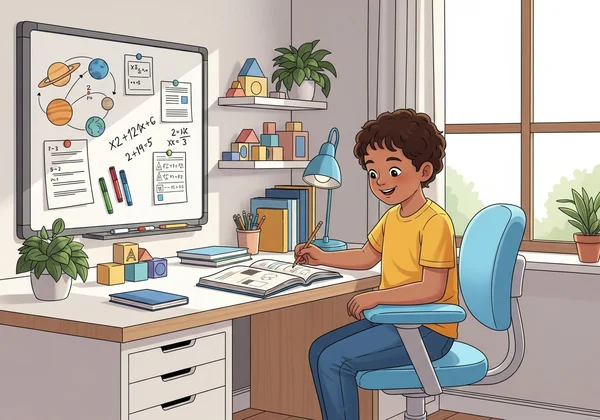
Setting Up a Visual Learner's Study Space
For a visual learner, a well-organized and visually stimulating study area is key.
- Use Color: Provide colored pens, highlighters, and sticky notes to help them organize information.
- Clear the Clutter: A messy desk can be distracting. A clean space helps them focus on the visual information in front of them.
- Display Information: Use a whiteboard or corkboard to post schedules, key facts, or diagrams. This keeps important information within their line of sight.
Communication Strategies for Auditory Learners
When communicating with an auditory learner, your words matter—and so does your tone.
- Talk It Out: Discuss their homework with them. Have them read passages aloud or explain a math concept back to you in their own words.
- Use Mnemonics: Create silly songs or rhymes to help them remember facts, like spelling rules or historical dates.
- Limit Noise: An auditory learner can be easily distracted by background noise. Ensure their study area is quiet during homework time.
Hands-On Activities for Kinesthetic Learners
A kinesthetic learner needs to move to learn. Incorporate physical activity into their learning routine.
- Build It: Use blocks to solve math problems, clay to sculpt historical figures, or role-playing to understand a story.
- Take Breaks: Encourage frequent, short breaks for physical activity. A few minutes of jumping jacks can help them reset and focus.
- Walk and Talk: Practice spelling words or multiplication tables while tossing a ball back and forth or walking around the room.
Conclusion
Putting Your Insights Into Practice
By observing your child at home, you’ve taken a powerful step toward understanding their unique educational needs. You've learned to spot the clues of visual, auditory, and kinesthetic preferences in their everyday activities and how to adapt your home to better support them. Remember, most children are a blend of styles, but they almost always have one that is dominant.
Your observations provide a fantastic foundation. Now, you can deepen that understanding and get a more structured profile of their learning preferences. This is where a formal tool can complement your real-world insights, turning your observations into a clear action plan.
Ready to gain deeper insights? Take our free Learning Style Quiz to receive a comprehensive analysis of your child's learning profile. Our AI-powered report provides personalized, actionable strategies you can use immediately to support their educational journey and help them succeed.
Frequently Asked Questions About Identifying Child Learning Styles
Common Concerns About Learning Style Identification
What age can you start identifying a child's learning style?
You can start noticing preferences in toddlers and preschoolers (ages 2-5). For example, a child who loves being read to might have auditory tendencies, while one who always reaches for puzzles may be more visual. However, these styles become more defined and consistent during the elementary school years (ages 6-10).
Can a child have more than one learning style?
Absolutely. In fact, most people are multimodal learners, meaning they use a combination of visual, auditory, and kinesthetic styles. However, one style is often more dominant, especially when learning new or challenging information. The goal is to identify their primary preference to provide the most effective support.
How often should I observe my child's learning behaviors?
Consistent, low-pressure observation is more effective than intense, short-term monitoring. Try to be mindful of their behaviors for a week or two to see clear patterns. It's also helpful to re-evaluate every year or so, as learning preferences can sometimes shift as a child develops and encounters new subjects.
What if my child doesn't fit neatly into one learning style category?
This is very common and completely normal. If your child shows a strong mix of all three styles, it means they are a versatile learner. You can support them by providing a variety of activities that appeal to all senses. To better understand their unique blend, you can try our free tool for a more detailed breakdown.
How accurate are home observations compared to formal assessments?
Home observations are incredibly valuable for understanding your child's natural tendencies in a comfortable environment. They provide authentic, real-world insights. A formal assessment, like our online quiz, complements your observations by providing a structured framework and data-backed analysis. Combining both gives you the most complete and accurate picture.