Kinesthetic Reading Strategies: Hands-On Ways to Improve Comprehension
Kinesthetic reading strategies help active learners turn reading from a still, silent task into something they can touch, move through, mark up, and explain. That does not mean every learner should be boxed into one fixed style. Learning preferences are best used as clues for designing better routines, not as labels that limit what someone can do. If reading feels hard to sustain, a movement-friendly approach can make the work more concrete: point to the text, map ideas on paper, stand while reviewing, act out scenes, or use short movement breaks between sections. For a broader starting point, you can also explore a learning preference quiz and compare the result with what actually helps during reading practice.
What Kinesthetic Means for Reading
A kinesthetic learner is often described as someone who learns more comfortably through movement, touch, physical examples, or hands-on practice. You may also see nearby terms such as tactile learner, physical learner, hands-on learner, or tactile kinesthetic learner. The word kinesthetic is commonly pronounced kin-uhs-THET-ik in American English.
For reading, the useful question is not, "Am I only a kinesthetic learner?" A better question is, "What physical actions help me notice, remember, and explain what I read?" Reading is not just eye movement across a page. Strong readers preview, question, infer, connect, summarize, and check whether the text still makes sense. Kinesthetic strategies give those invisible thinking moves a visible action.
That distinction matters because the research conversation around learning styles is cautious. Many educators now avoid promising that matching instruction to one preferred style will automatically improve achievement. A safer, more practical approach is to use movement as one tool among many: combine tactile activity with clear instruction, vocabulary work, discussion, visual organizers, and repeated practice.
Best Kinesthetic Reading Strategies to Try First
The best kinesthetic reading strategies are simple enough to repeat. Start with one or two, then keep the ones that improve comprehension rather than the ones that only make reading feel busy.
1. Annotate With a Purpose
Give your hands a job before you begin. Use one symbol for confusing lines, one for important evidence, one for unfamiliar vocabulary, and one for a personal connection. This turns reading into a sequence of small decisions. Instead of highlighting entire paragraphs, you are sorting the text as you move through it.
For a younger reader, use sticky notes rather than writing in the book. For an adult learner, try a margin code such as Q for question, E for evidence, and S for summary. The physical act matters, but the goal is thinking.
2. Build a Passage Map
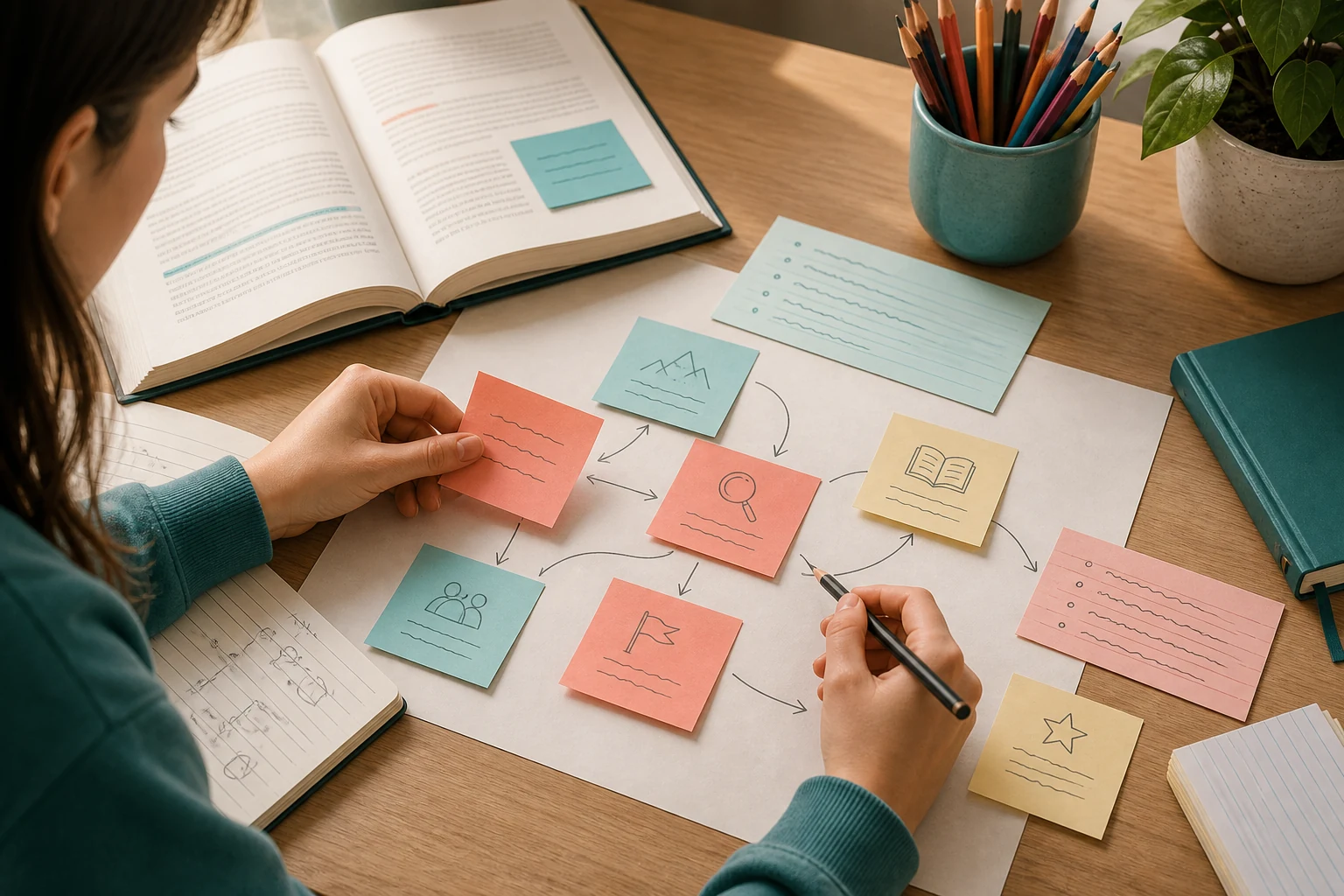
After a section, close the book and build a quick map from memory. Put the main idea in the center, supporting details around it, and arrows between causes, examples, or contrasts. You can do this on a whiteboard, notebook page, floor cards, or movable sticky notes.
This works especially well for nonfiction, science reading, history chapters, and long articles. If the map is messy, that is useful feedback. It shows where the text needs a second read.
3. Walk, Stop, and Summarize
Many active learners focus better when reading is broken into short physical cycles. Read one page or one subsection. Stand up, take a short walk, then say a one-sentence summary before sitting down again. If you cannot summarize it, reread the last paragraph and try again.
The movement break should be brief and predictable. The purpose is to reset attention and rehearse meaning, not to avoid the text.
4. Use Finger Tracking or a Reading Guide
Finger tracking, a bookmark, or a plain index card can help readers keep their place and slow down just enough to process meaning. This is not only for early readers. Adults who read dense material may also benefit from a physical guide when the text is technical, crowded, or visually distracting.
Try sliding the card line by line, then pausing at the end of each paragraph to name the point. If the tool helps comprehension, keep it. If it becomes distracting, drop it.
Kinesthetic Reading Strategies in the Classroom
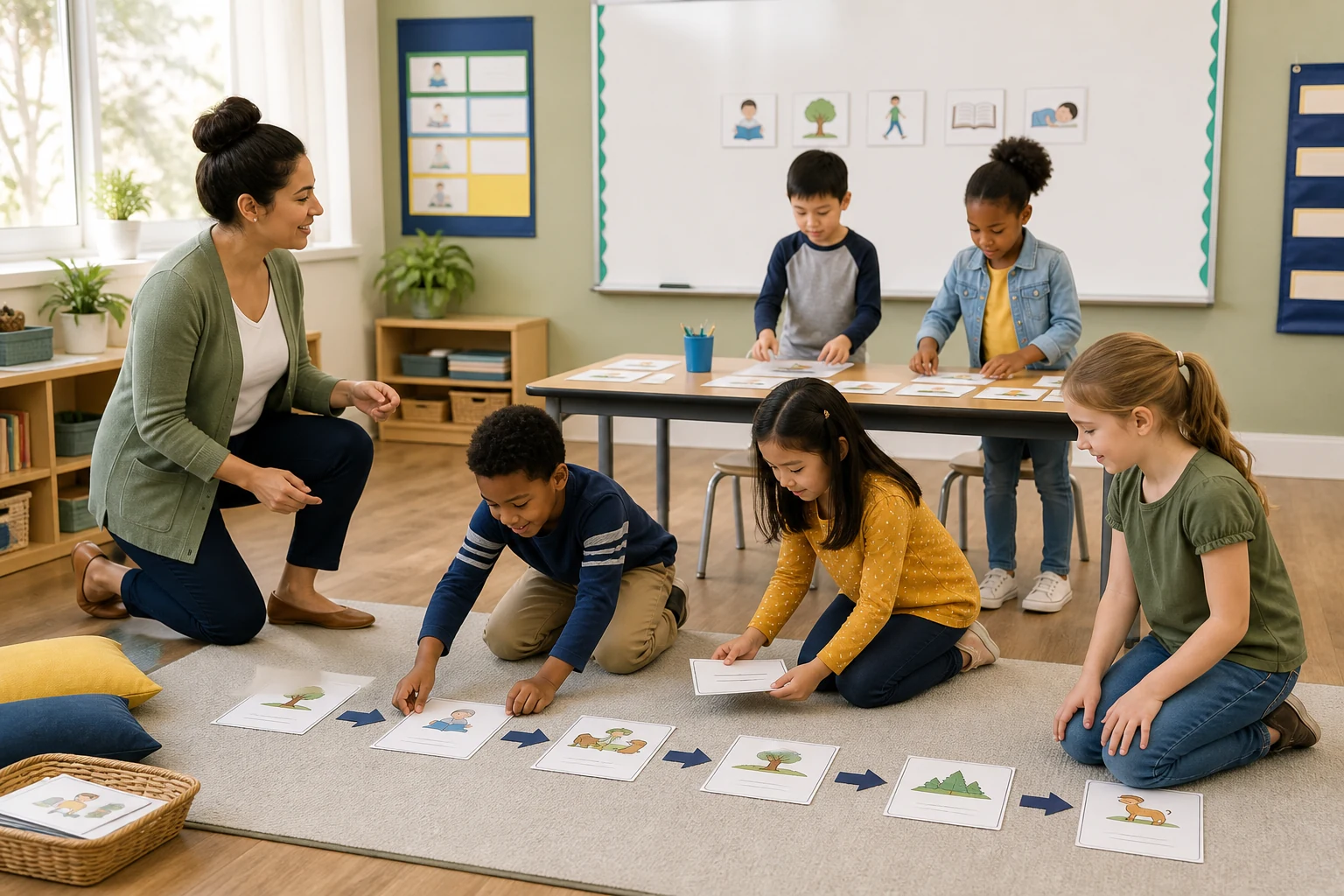
Classroom kinesthetic strategies work best when movement is structured. Students need a clear reading goal, a physical task, and a short reflection afterward. Movement without reflection can become noise; reflection without engagement can become abstract.
For classroom use, match the activity to the reading skill:
- Phonics or word recognition: build words with letter cards, tap syllables, trace sound patterns, or sort word families.
- Vocabulary: act out a term, match word cards to examples, or place words along a physical continuum from weak to strong.
- Comprehension: use story sequence cards, walk to evidence posted around the room, or pass a discussion object while retelling.
- Main idea: have students stand beside the sentence strip that best captures a paragraph, then defend the choice.
- Inference: place clue cards on one side of the room and conclusion cards on the other, then ask students to connect them.
These activities are strongest when they end with reading or writing. For example, after students hop through a word ladder, ask them to read the words aloud in a sentence. After a story-sequence activity, ask them to write a three-sentence retell. The action opens the door; the literacy task completes the learning.
If you are trying to understand whether movement helps your own study routine, explore your study preferences and then test one classroom-style strategy during your next reading session.
Kinesthetic Reading Strategies for Adults
Kinesthetic learning examples for adults should respect real schedules. Most adults are not going to turn every reading session into a classroom activity. The key is to add small physical supports that fit work, college, certification study, or self-improvement reading.
Try these adult-friendly options:
- Stand for the preview. Before reading, stand at a counter and scan headings, captions, charts, and first sentences.
- Use index cards for claims. Write each major claim on a card, then arrange the cards into an argument map.
- Read with a pen in hand. Underline sparingly, draw brackets around examples, and write one action verb in the margin: compare, define, prove, warn, or contrast.
- Pace during recall. After a section, walk slowly and explain the point aloud as if teaching it to a colleague.
- Turn notes into a checklist. If the text teaches a process, convert it into steps you can physically check off.
Adults often need kinesthetic strategies for retention, not entertainment. A certification manual, workplace policy, or dense textbook becomes easier to manage when the reader can transform it into cards, diagrams, spoken recall, or practice steps.
The 5-4-3-2-1 Reading Strategy for Active Learners
The 5-4-3-2-1 reading strategy is a flexible way to slow down and process a text after reading. It is often adapted by teachers, so the exact wording can vary. A kinesthetic version might look like this:
- 5 key details you can point to in the text.
- 4 unfamiliar or powerful words to mark.
- 3 connections to prior knowledge, another text, or real life.
- 2 questions you still have.
- 1 sentence that summarizes the main idea.
To make it physical, place five sticky notes on the page, move four vocabulary cards into a "review" pile, draw three arrows for connections, write two questions on a small board, and stand up to say the one-sentence summary. This turns comprehension monitoring into a visible routine.

Common Mistakes When Using Kinesthetic Strategies
The first mistake is adding movement that does not serve reading. If a student is bouncing between tasks but cannot explain the paragraph, the strategy needs tightening. Movement should point back to the text.
The second mistake is using one activity for every reading problem. A sight-word game will not fix weak inference. A summary walk will not teach phonics. Name the reading skill first, then choose the movement.
The third mistake is treating kinesthetic preference as a fixed identity. A reader may prefer movement during vocabulary practice but need quiet during analysis. Another reader may like hands-on work for science texts but not for novels. Preferences shift with age, topic, difficulty, and attention.
The fourth mistake is ignoring signs of a bigger concern. If a learner has persistent reading difficulty, frequent frustration, or major attention challenges, movement-based strategies can be supportive, but they are not a substitute for qualified educational evaluation or professional guidance.
Build a Reading Routine Around Movement and Meaning
A strong routine is small, repeatable, and honest about results. Choose one short text and run this sequence:
- Preview the text while standing.
- Read one section with a pen, card, or finger guide.
- Mark only what serves a purpose.
- Build a quick map or card sort from memory.
- Move briefly, then say a one-sentence summary.
- Reread the part you could not explain.
Use that routine for a week before adding more strategies. Notice whether you remember more, avoid rereading less, or explain ideas more clearly. If a strategy helps, keep it. If it only adds motion, simplify it.
Kinesthetic reading strategies are most useful when they make comprehension visible. They help readers touch the structure of a text, move through ideas, and turn reading into active meaning-making. To connect these experiments with a broader self-reflection process, you can review your learning style profile and use the result as one input for choosing your next reading habit.

FAQ
What are some kinesthetic learning strategies?
Kinesthetic learning strategies include annotating with a pen, building concept maps, sorting cards, tracing words, tapping syllables, acting out vocabulary, using learning stations, pacing during recall, and turning notes into checklists. For reading, the best strategy is the one that connects movement to a specific comprehension task.
What is the 5 4 3 2 1 reading strategy?
It is a reflection routine that asks readers to identify five details, four words, three connections, two questions, and one summary sentence. A kinesthetic version uses sticky notes, cards, movement, and spoken recall so the reader can physically organize the ideas.
What are the four types of reading strategies?
One practical set is predicting, questioning, clarifying, and summarizing. Readers predict what the text may say, ask questions while reading, clarify confusing parts, and summarize the main idea. Kinesthetic readers can pair each step with an action, such as moving cards, marking evidence, or saying a summary aloud.
Is kinesthetic learning linked to ADHD?
Kinesthetic learning and ADHD are not the same thing. Some learners with attention challenges may benefit from planned movement, breaks, or fidget tools, while others may find certain movement distracting. A learning preference does not identify ADHD. If attention, reading, or school functioning is a serious concern, it is best to speak with qualified educational or health professionals.
Are kinesthetic reading strategies only for children?
No. Adults can use movement-friendly reading routines too. Card sorting, standing previews, handwritten margin notes, spoken recall, and short walking reviews can help with textbooks, workplace documents, exam preparation, and professional learning.
Can kinesthetic strategies replace regular reading instruction?
No. They should support reading instruction, not replace it. Readers still need vocabulary, phonics when appropriate, fluency practice, background knowledge, comprehension strategies, and opportunities to discuss and write about texts. Movement is most helpful when it strengthens those core skills.