Learning Methods and Strategies: A Practical Guide for Students and Teachers
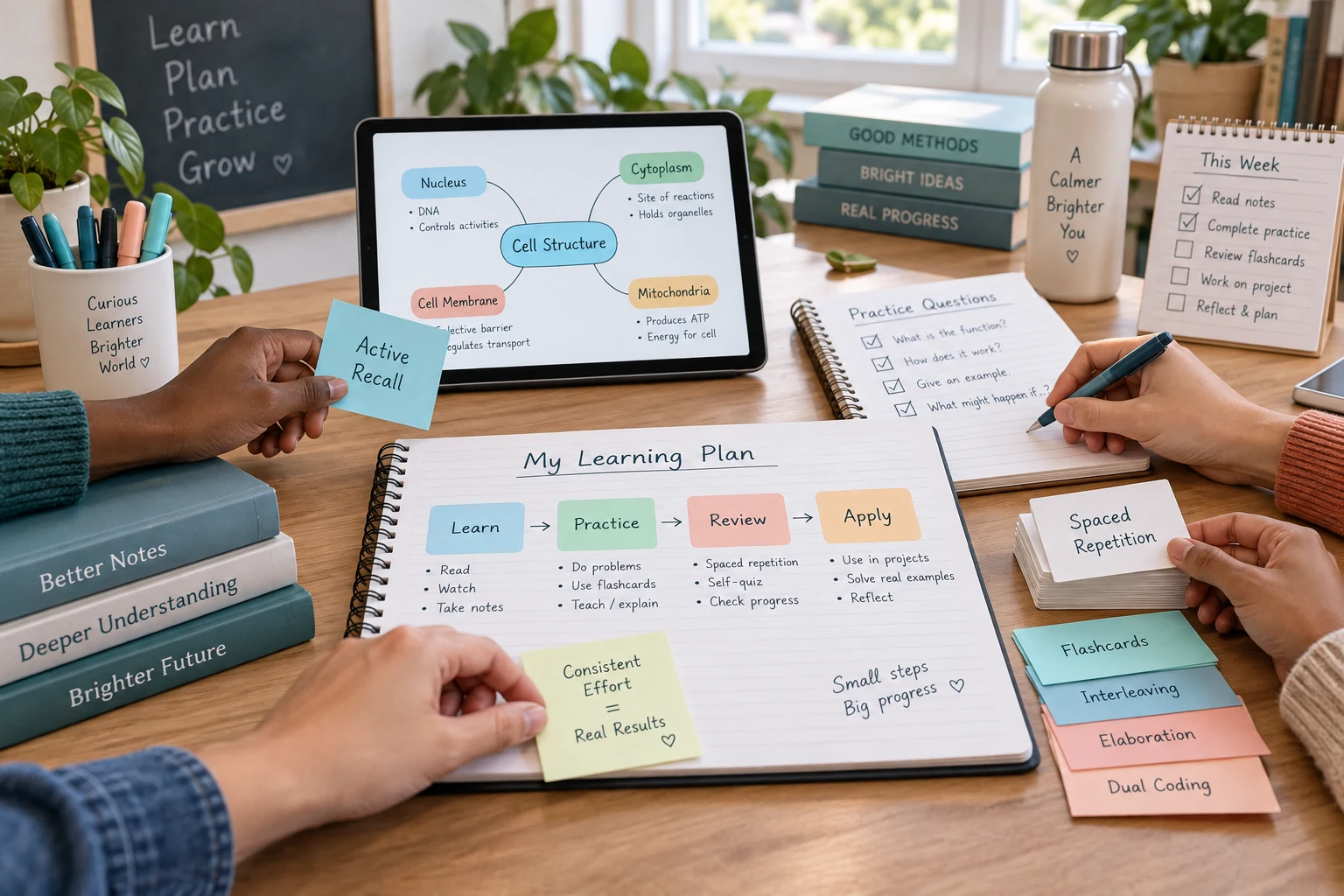
Learning methods and strategies are easiest to use when you treat them as two parts of the same system. A method is the way learning happens, such as reading, listening, discussing, practicing, teaching, or building. A strategy is the purposeful move that makes the method more effective, such as retrieval practice, spaced review, concept mapping, self-questioning, or reflection. If you want a simple starting point, use a learning preference check-in from an educational learning style quiz as one clue, then combine it with evidence-informed study habits and classroom routines. The goal is not to label a learner forever. The goal is to choose better actions for the next lesson, assignment, exam, or project.
What Are Learning Methods and Strategies?
Learning methods are the broad formats you use to engage with information. Common examples include direct instruction, reading, note-taking, discussion, demonstration, problem solving, simulation, project work, and peer teaching. These methods describe the channel or activity.
Learning strategies are the deliberate techniques that improve attention, understanding, memory, transfer, or self-management. For example, a student may read a chapter as the method, then use retrieval questions, margin summaries, and spaced review as strategies. A teacher may use small-group discussion as the method, then add accountable talk prompts, quick checks for understanding, and reflection tickets as strategies.
This distinction matters because a method can look active without producing deep learning. Highlighting a page, watching a video, or joining a group can feel productive, but the learner still needs to process, recall, explain, apply, and monitor understanding. Strong strategies make the method do real work.
Four Types of Learning Strategies
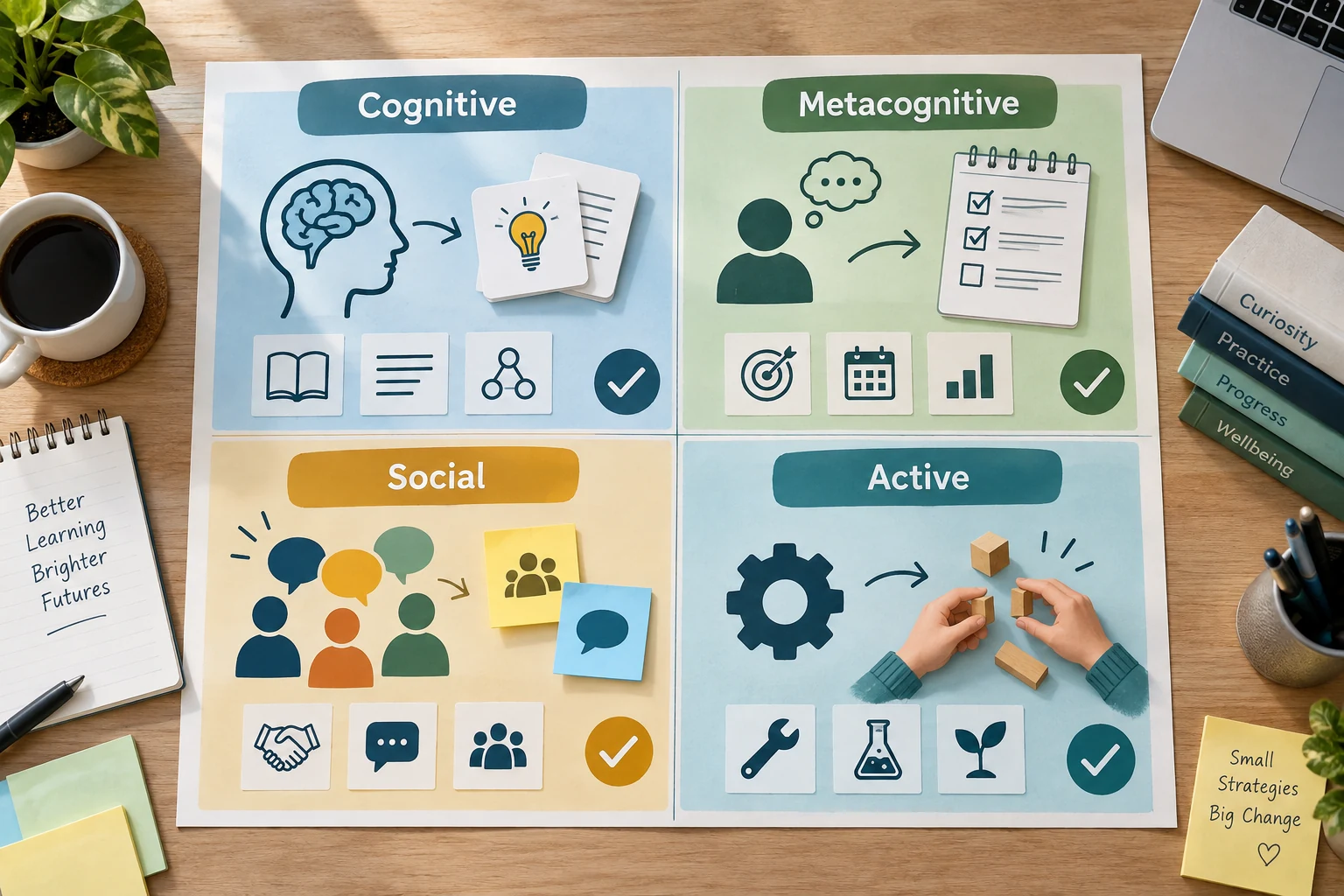
Many lists describe four types of learning strategies: cognitive, metacognitive, social, and affective or motivational. A practical classroom version can also include active or experiential strategies as a major category because hands-on learning is common in science, arts, career training, and project-based lessons.
Cognitive learning strategies help learners understand and remember content. Examples include summarizing, elaboration, dual coding, concept mapping, flashcards, worked examples, and comparing similar ideas. These strategies are useful when the learner needs to build knowledge that can be recalled and applied later.
Metacognitive strategies help learners plan, monitor, and adjust. Examples include setting a goal before studying, checking which ideas are still unclear, choosing a new approach after a low quiz score, and reflecting on what worked. These strategies help students become less dependent on guesswork.
Social strategies use interaction to support learning. Examples include peer explanation, study groups, debate, think-pair-share, peer feedback, and collaborative problem solving. These are especially useful when learners need to test their reasoning or hear another explanation.
Active strategies require learners to do something with the material. Examples include practice problems, simulations, labs, role play, teaching the concept to someone else, creating a model, or applying a rule to a new case. Active learning is strongest when the activity is connected to a clear learning goal.
Effective Learning Methods and Strategies Examples
A useful strategy list should be specific enough to act on. Here are examples that work for many students and can be adapted by teachers.
Retrieval practice means trying to remember before looking at the answer. Students can close their notes and write everything they know, answer practice questions, use flashcards, or explain a process from memory. Retrieval is more demanding than rereading, but that effort is part of why it helps.
Spaced repetition means reviewing material over time instead of cramming in one long session. A simple schedule might include a short review after class, another review two days later, and a final review the next week. This works especially well with vocabulary, formulas, timelines, definitions, and procedures.
Elaboration means adding meaning by asking why, how, and what else. A learner might connect a biology term to a lab observation, link a history event to a cause-and-effect chain, or explain how a math rule changes when the numbers change.
Dual coding means combining words with visuals. Students can pair notes with diagrams, timelines, flowcharts, labeled sketches, or comparison tables. This is not only for visual learners. It helps many learners organize ideas because the same concept is represented in more than one way.
Interleaving means mixing related problem types instead of practicing one type in a long block. For example, a math review session might include fractions, ratios, and equations together so the learner must decide which method fits each problem.
Self-explanation means pausing to explain each step in your own words. This can turn a passive example into active reasoning. It is useful for worked math problems, grammar rules, coding exercises, science processes, and reading comprehension.
Learning Strategies for Students
Students often ask for the best way to study, but the better question is: what job does this study session need to do? If the goal is first exposure, choose a method that helps you understand the basics: read a short section, watch a lesson, listen to an explanation, or review an example. If the goal is memory, use retrieval and spacing. If the goal is application, solve problems, compare cases, or create something.
A simple student routine can follow four steps. First, preview the topic and set a goal. Second, learn the material through reading, listening, demonstration, or guided instruction. Third, practice without looking at the answer too quickly. Fourth, reflect by asking what still feels weak and when you will review it again.
Students can also adapt strategies to their learning preferences without treating preferences as fixed rules. Someone who enjoys visual material might use concept maps and diagrams, but should still practice recall. Someone who likes listening might record short explanations or discuss ideas with a study partner, but should still write and solve. Someone who prefers hands-on learning might build models or run practice tasks, but should still connect the activity to vocabulary and concepts. If you want a low-pressure way to notice those preferences, a learning preference quiz can support reflection before you choose your next study routine.
Learning Methods and Strategies in the Classroom
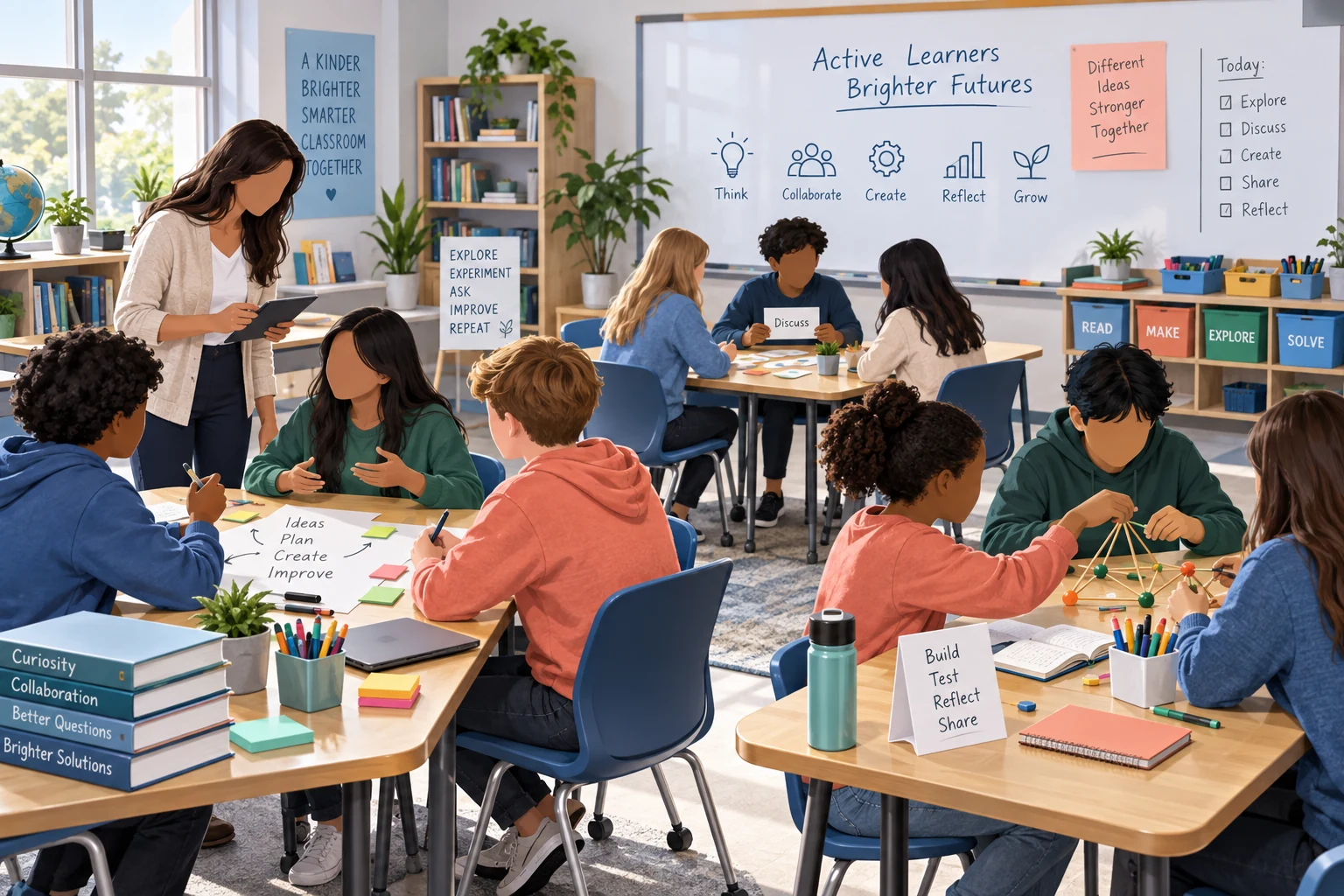
In teaching, methods and strategies should connect to the learning target. If students need background knowledge, direct instruction, reading, guided notes, and examples may be efficient. If students need analysis, discussion, comparison, and debate can help. If students need skill fluency, practice with feedback matters. If students need transfer, projects, simulations, and real-world tasks can make the learning more flexible.
Teachers can make classroom strategies stronger by naming the purpose. Instead of saying, "Get into groups," say, "Compare your solution with a partner and find one difference in reasoning." Instead of saying, "Review your notes," say, "Cover your notes and write three ideas from memory, then check what you missed." The strategy becomes clearer, and students learn how to use it independently.
Strong classrooms also combine individual, pair, and whole-class learning. A lesson might begin with a short explanation, move into individual retrieval, shift to partner discussion, and end with an exit ticket. That sequence gives students multiple chances to process the same idea.
How to Choose the Right Strategy
Start with the learning problem, not the trendiest technique. If a learner forgets quickly, use retrieval and spaced review. If a learner understands examples but freezes on new problems, use interleaving and self-explanation. If a learner cannot see how ideas connect, use concept mapping, comparison tables, or elaboration. If a learner loses focus, use shorter study blocks, clear goals, and quick checks for progress.
For teachers, the same logic applies. A lively activity is not automatically the best choice. A quiet retrieval quiz may be better than a complex group task when students need memory practice. A discussion may be better than a worksheet when students need to compare viewpoints. A project may be better than a lecture when students need to apply ideas across steps.
One helpful filter is to ask three questions: What should learners know or do by the end? What kind of thinking will prove they can do it? What support will help them attempt that thinking without doing it for them? The answers point toward a method and a strategy.
Common Mistakes to Avoid
The first mistake is matching every lesson to one learning style. Learning preferences can be useful for reflection, but students benefit from flexible practice across reading, listening, seeing, discussing, and doing. A student who prefers diagrams still needs words. A student who prefers discussion still needs independent recall.
The second mistake is confusing time spent with learning gained. Long study sessions can produce little progress if they are mostly rereading or copying. Short sessions can be powerful when they include recall, feedback, and spacing.
The third mistake is using active learning without accountability. Movement, group work, and projects help only when students think with the content. Add prompts, products, explanations, or checkpoints so the activity supports the goal.
The fourth mistake is skipping reflection. Learners need to know which strategies helped, which ones felt easy but shallow, and what should change next time.
Build Your Personal Learning Strategy Mix
The best learning methods and strategies form a mix, not a single magic routine. Choose one method for input, one strategy for processing, one strategy for recall, and one habit for reflection. For example: watch a short lesson, create a concept map, answer five questions from memory, then schedule a review. Or read a chapter, summarize each section, teach the main idea to a peer, then mark the confusing parts for follow-up.
For students, the next step is to test a small strategy mix for one week and notice what changes. For teachers and parents, the next step is to help learners name the strategy they are using, not just the assignment they are completing. When learners understand both their preferences and their options, they can become more flexible. You can also use a self-reflection learning tool as a gentle starting point for discussing how a learner likes to receive, practice, and apply information.
FAQ
What are the four types of learning methods?
A practical grouping is visual, auditory, reading and writing, and kinesthetic or hands-on methods. In classroom planning, you may also see direct instruction, discussion, practice, and experiential learning. These categories are useful as options, but learners usually benefit from a blend rather than one method only.
What are five types of learning strategies?
Five useful types are cognitive, metacognitive, social, active, and motivational strategies. Cognitive strategies build understanding and memory. Metacognitive strategies guide planning and monitoring. Social strategies use interaction. Active strategies involve doing and applying. Motivational strategies support focus, confidence, and persistence.
What are seven learning techniques students can use?
Seven helpful techniques are retrieval practice, spaced repetition, elaboration, dual coding, interleaving, self-explanation, and reflection. Students can combine them with ordinary methods like reading, listening, taking notes, watching a lesson, or joining a study group.
What are ten effective learning strategies?
Ten effective strategies include goal setting, active note-taking, retrieval practice, spaced review, summarizing, concept mapping, elaboration, interleaving, peer teaching, and reflection. The best choice depends on the goal, the subject, and the learner's current challenge.
Are learning strategies the same as teaching strategies?
They overlap, but they are not exactly the same. Learning strategies are actions learners use to understand, remember, and apply information. Teaching strategies are choices educators use to design instruction, guide practice, and support students. A strong lesson often teaches students how to use learning strategies for themselves.
How do learning styles fit into learning strategies?
Learning styles can help learners reflect on preferences, such as whether they enjoy diagrams, discussion, reading, or hands-on practice. They should not be treated as fixed limits. A balanced plan uses preferences as a starting clue, then adds strategies that support memory, understanding, application, and self-monitoring.