Learning Style Quiz for Adults: Unlock Your Career Potential
Are you feeling stagnant in your career or struggling to master new skills at work? In today's fast-paced professional world, continuous learning is not just an advantage—it's a necessity. But what if the way you've been taught to learn isn't the way you learn best? Unlock your true potential by understanding your unique learning style. This guide is designed for professionals ready to leverage their innate visual, auditory, or kinesthetic preferences to boost performance, improve collaboration, and accelerate professional development. Discovering your learning styles for adults can be the game-changer you need, but first, you have to ask: What kind of learner am I? The best way to find out is through a free learning style quiz designed for professionals.
This guide will walk you through how to identify and apply your strengths in a professional setting. To get started on your journey of self-discovery, you can find your learning style with our quick, free assessment.

Why Understanding Your Adult Learning Style Fuels Growth
Identifying your learning preference isn't just an academic exercise; it's a strategic tool for career advancement. When you align your daily tasks, training, and development goals with your natural cognitive strengths, you work smarter, not harder. This understanding transforms frustrating challenges into opportunities for growth, making workplace learning more efficient and enjoyable. You retain information better, solve problems more creatively, and communicate more effectively.
The VAK Model: How Visual, Auditory, & Kinesthetic Learning Shapes You
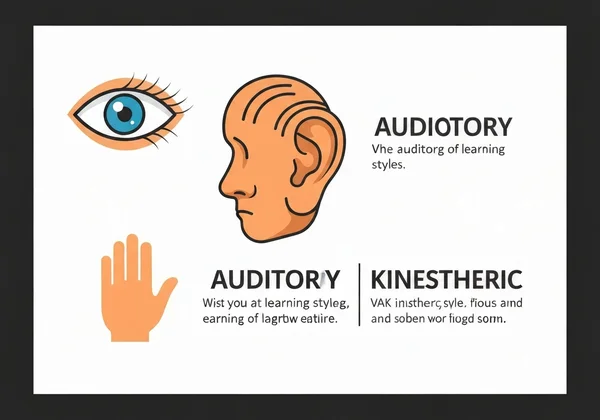
The most widely recognized framework is the VAK model, which categorizes learning preferences into three primary types. While most people are a blend, they typically have a dominant style:
- Visual Learners: Prefer seeing and observing things, including pictures, diagrams, and written instructions. They often think in pictures and learn best from visual displays.
- Auditory Learners: Learn best through listening. They thrive on sound, music, discussions, and lectures. They are adept at interpreting tone of voice, pitch, and other nuances.
- Kinesthetic Learners: Learn by doing, touching, and moving. They prefer a hands-on approach and absorb information best through physical experience and application.
Understanding this VAK model is the first step toward tailoring your professional environment for success.
Connecting Your Learning Style to Workplace Challenges
Think about common workplace hurdles. Do you zone out during long conference calls? You might be a visual or kinesthetic learner struggling in an auditory-heavy environment. Do you find written reports dense and hard to follow? You could be an auditory learner who would benefit from a verbal summary. By connecting your style to these challenges, you can proactively seek solutions that play to your strengths, turning points of friction into avenues for mastery.
Visual Learning Strategies for Workplace Mastery
For visual learners, the phrase "a picture is worth a thousand words" is a fundamental truth. To excel professionally, you must turn abstract concepts and data into tangible, visual formats. This approach enhances comprehension and retention, making complex tasks more manageable and improving overall professional development.
From Presentations to Project Plans: Visualizing Success
Transform your workspace and tasks to be more visually engaging. When creating or consuming presentations, focus on charts, graphs, and infographics over dense text. For project management, use tools like Gantt charts, color-coded spreadsheets, or Kanban boards to visualize workflows and progress. Even something as simple as using different colored highlighters for notes can make a significant impact.
Leveraging Mind Maps & Diagrams for Complex Information
When faced with complex information or a brainstorming session, a mind map is your best friend. This technique allows you to organize thoughts radially, creating a clear visual hierarchy that mirrors how your brain processes ideas. Flowcharts and diagrams are equally powerful for deconstructing processes or systems. These tools don't just organize information; they help you see connections and patterns you might otherwise miss. Ready to see which strategies work best for you? Take the free quiz to start.
Auditory Learning: Elevating Communication & Skill Acquisition
Auditory learners thrive in environments rich with sound and conversation. Your greatest assets are your ears and your voice. In a professional setting, this translates to superior communication skills and an ability to absorb knowledge through discussion and listening. Honing these skills is a direct path to greater influence and more effective career growth tips.
Mastering Meetings: Active Listening & Verbal Processing
Meetings can be a goldmine for auditory learners if approached correctly. Practice active listening by paraphrasing what others have said to confirm your understanding ("So, if I hear you correctly, the priority is..."). Don't be afraid to think out loud; verbal processing is how you make sense of information. Participating in discussions, asking clarifying questions, and volunteering to present findings will solidify your understanding and showcase your expertise.
Audio Resources: Podcasts & Explanations for Continuous Learning
Embrace the wealth of audio content available today. Supplement your professional reading with industry-specific podcasts, audiobooks, and recorded webinars. When learning a new software or process, ask a colleague for a verbal walkthrough instead of relying solely on a written manual. This commitment to continuous learning through auditory channels will keep you ahead of the curve.
Kinesthetic Learning: Practical Approaches for Career Advancement
Kinesthetic learners are the "doers" of the world. You learn best when you are physically engaged in the learning process. Sitting still through a long presentation is your nightmare; you need to build, create, and interact. Applying this need for action is crucial for turning your hands-on nature into tangible workplace learning success.

Learning By Doing: Experiential Training & Role-Playing
Seek out opportunities for experiential learning. Instead of just reading about a new technique, find a way to apply it immediately, even on a small scale. Workshops, simulations, and apprenticeships are ideal formats. Role-playing is an incredibly effective tool for mastering interpersonal skills, such as sales pitches, negotiations, or conflict resolution. It allows you to build muscle memory for real-world scenarios.
Integrating Movement & Physical Engagement for Focus
Your need for movement isn't a distraction; it's a requirement for focus. Integrate physical engagement into your workday. Use a standing desk, walk around while on the phone, or take frequent breaks to stretch. When brainstorming, use a whiteboard to physically write and draw out your ideas. Tapping a pen or squeezing a stress ball can also help channel your energy and improve concentration during passive tasks. Don't wait to harness your energy—discover your personal style now.
Beyond Your Style: Enhancing Team Collaboration & Professional Development
Understanding your own learning style is only half the battle. The true mark of a highly effective professional is the ability to recognize and adapt to the learning styles of others. This awareness transforms team dynamics, boosts productivity, and fosters a more inclusive and effective work environment.
Adapting Your Communication to Diverse Learning Preferences
Once you know your style, start observing your colleagues. Is your manager a visual learner who loves a good chart? Make sure your reports are visually compelling. Does your teammate need to talk through ideas to understand them? Schedule a brief chat instead of sending a long email. Mastering these adaptive communication skills makes you a more effective collaborator and leader.
Cultivating a Learning Culture: Supporting All Styles in Your Team
Advocate for a multi-modal approach to training and information sharing. When leading a project or meeting, try to incorporate elements that appeal to all three styles. Provide a written agenda (visual), lead a verbal discussion (auditory), and include an interactive component or a clear next step for action (kinesthetic). By championing a flexible learning culture, you empower everyone on your team to perform at their best.
Your Next Step: Unlock Your Potential Today
Your learning style is the unique blueprint for how you best absorb and process information. By understanding whether you are a visual, auditory, or kinesthetic learner, you can transform your approach to professional development, turn weaknesses into strengths, and unlock new levels of productivity and career satisfaction. This isn't about fitting into a box; it's about building a toolkit of strategies that align with your natural abilities.
The journey begins with a single step: self-awareness. Stop guessing and start knowing. Take our free learning style quiz to receive an instant, personalized profile of your learning preferences. It's fast, requires no registration, and provides the actionable insights you need to begin optimizing your career today.

Frequently Asked Questions About Learning Styles & Career Growth
How do you identify your learning style for professional growth?
The most effective way is through a self-assessment designed to pinpoint your preferences. A good quiz will ask questions about how you approach different tasks, from learning a new skill to giving directions. The goal is to identify patterns in your behavior. Our free, data-driven learning styles quiz is an excellent starting point for any professional.
What kind of learner am I in the workplace?
Reflect on your daily tasks. Do you prefer reading reports and seeing data in charts (visual)? Do you get the most out of team discussions and phone calls (auditory)? Or do you learn best by diving in and trying a new process yourself (kinesthetic)? Answering these questions provides clues, but a structured test provides a much clearer picture.
How can adults improve their professional skills based on their learning style?
Once you know your style, you can intentionally choose learning methods that suit you. Visual learners can use mind maps and instructional videos. Auditory learners can listen to industry podcasts and engage in mentorship discussions. Kinesthetic learners should seek hands-on workshops and apply new skills immediately in real-world projects.
Which is the most effective learning style for career advancement?
No single learning style is "better" than another. Each has unique strengths. The most effective professionals are those who not only leverage their dominant style but also develop strategies to adapt in situations that cater to other styles. The key to advancement is self-awareness and flexibility, not conforming to a single method.
Are there more than three primary learning styles for adults?
Yes, the VAK model is a foundational framework, but other models exist, such as VARK (which adds Reading/Writing as a fourth style) and Kolb's model of experiential learning. However, the Visual, Auditory, and Kinesthetic categories provide a simple yet powerful lens for understanding your core preferences and making immediate improvements in your professional life.