What Are Tactile Learners? Characteristics, Examples, and Study Tips
Tactile learners are people who tend to understand information best when they can touch, handle, build, trace, sort, or physically interact with what they are learning. Instead of only listening to a lecture or staring at a diagram, they often benefit from turning ideas into something concrete. That might mean using flashcards, sketching a model, moving puzzle pieces, writing notes by hand, or practicing a skill with real materials. The goal is not to label anyone permanently. A learning style self-reflection tool can simply give students, parents, and educators a useful starting point for choosing study strategies that feel more active, memorable, and practical.
What Does Tactile Learner Mean?
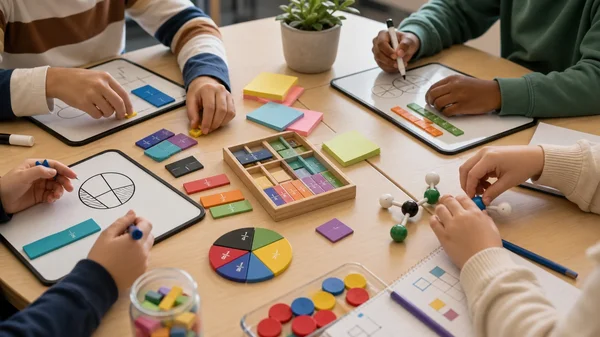
A tactile learner prefers to learn through touch and physical engagement. The word "tactile" comes from touch, so tactile learning is closely connected to texture, pressure, shape, writing, assembling, and manipulating objects. In a classroom, a tactile learner may remember a science concept better after building a model than after reading the same explanation twice. In independent study, that person may retain vocabulary better by sorting word cards, writing sample sentences by hand, or pairing terms with small physical cues.
Tactile learning is often discussed beside visual, auditory, reading/writing, and kinesthetic preferences. These categories can be helpful when they are treated as flexible preferences, not fixed identities. Many people use a blend. A student might like tactile study for math, auditory discussion for history, and visual diagrams for biology. The useful question is not "What single type am I forever?" but "Which learning method helps this topic make sense right now?"
Common tactile learner characteristics
Tactile learner characteristics often show up in small habits rather than dramatic behaviors. A tactile learner may:
- Prefer writing notes, drawing margins, or highlighting by hand.
- Remember steps after doing them rather than only hearing them.
- Enjoy manipulatives, models, lab materials, cards, maps, or physical examples.
- Fidget with pens, paper, textured objects, or study tools while thinking.
- Break information into movable parts, such as sticky notes or index cards.
- Feel more focused when a lesson includes practice, building, tracing, or sorting.
These traits do not mean someone cannot learn from reading, listening, or watching. They simply suggest that touch and action may help the learner encode information more deeply.
Tactile learning examples
An example of a tactile learner is a student who studies fractions by cutting paper circles into halves, thirds, and fourths before solving problems on a worksheet. Another example is a nursing student who practices procedures on a training model before reviewing written steps. A language learner might write vocabulary on cards, group them by theme, and move them into "know," "review," and "practice" piles.
Tactile learning examples can be simple. You do not need expensive equipment. Paper strips, sticky notes, coins, string, clay, blocks, whiteboards, printed diagrams, and handwritten checklists can all turn abstract information into something the learner can touch.
Tactile Learner vs Kinesthetic Learner
The tactile learner vs kinesthetic learner distinction can be confusing because both involve active learning. The easiest way to separate them is this: tactile learning centers on touch and hands-on materials, while kinesthetic learning centers on whole-body movement and physical experience.
For example, a tactile learner studying geography might trace a raised map, move labeled cards onto regions, or build a small landform model. A kinesthetic learner might remember the same content by walking across a floor map, acting out trade routes, or moving to different corners of the room for review questions. A kinesthetic tactile learner may need both: objects to handle and movement to support attention.
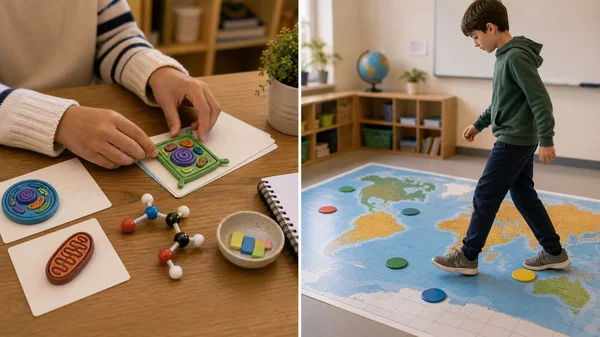
The tactile and kinesthetic difference matters because the best support may not be the same. A learner who needs touch may benefit from manipulatives while remaining seated. A learner who needs movement may need short standing tasks, lab stations, role-play, or walking review. Teachers can combine both, but noticing the difference helps avoid using "hands-on" as a vague catchall.
Tactile Learner vs Visual, Auditory, and Reading/Writing Learners
Many learning style models describe four broad preferences: visual, auditory, reading/writing, and kinesthetic. Tactile learning is sometimes grouped with kinesthetic learning because both are active and physical. In practical study planning, tactile learning deserves its own attention because touching materials is different from simply moving around.
A tactile learner vs visual learner comparison shows the difference clearly. A visual learner may prefer charts, color-coded diagrams, videos, and spatial layouts. A tactile learner may also like diagrams, but the learning improves when the diagram becomes interactive: labels can be moved, parts can be traced, or the concept can be built.
An auditory learner may prefer discussion, explanation, spoken repetition, or teaching the idea aloud. A tactile learner may combine sound with action by saying each step while writing it, tapping a rhythm for a sequence, or using cards during a study conversation. A reading/writing learner may prefer lists, textbooks, summaries, and written definitions. A tactile learner can use writing too, especially when the act of handwriting, rewriting, cutting, grouping, or annotating becomes part of the memory process.
The strongest study routines usually blend modes. For example, a student might watch a visual explanation, talk through the process, write a summary, and then use a tactile activity to practice the idea. That blend is often more useful than trying to force every topic into one preferred style.
Practical Tactile Learning Activities and Tools
Good tactile learning activities turn information into something the learner can handle, arrange, or physically practice. If you are exploring your own preferences, a learning preference quiz can help you reflect on which strategies feel natural, but the real value comes from testing those strategies on actual schoolwork.
At home or during independent study
Try these tactile learning tools and activities when studying alone:
- Use index cards to sort facts into categories, timelines, or cause-and-effect chains.
- Rewrite key formulas, definitions, or steps by hand on a whiteboard.
- Build quick models from paper, clay, blocks, or household objects.
- Turn a chapter outline into sticky notes and physically rearrange the structure.
- Use textured bookmarks, tabs, or color cards to mark different kinds of information.
- Practice spelling, equations, or sequences by tracing them on paper before testing recall.
- Create a "teach it with objects" routine: choose three items on your desk and use them to explain the concept.
For digital study, tactile learners can still add physical contact. Print a one-page diagram, annotate it by hand, use a tablet stylus, or keep a paper problem log beside the screen. The point is to give the brain a physical pathway into the material.
Tactile teaching in classrooms
Tactile teaching does not have to take over the whole lesson. A teacher might add a five-minute object sort, a station activity, a mini whiteboard response, or a model-building task after direct instruction. In math, students can use counters, number lines, fraction pieces, or folded paper. In science, they can handle specimens, build molecule models, or arrange process cards. In reading, they can sequence plot events with cards, annotate printed passages, or map character relationships with sticky notes.
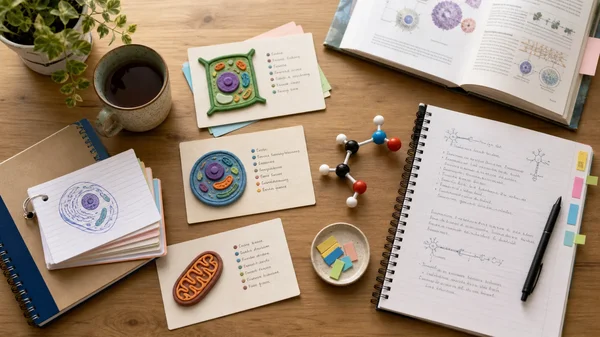
The key is purpose. A tactile activity should connect directly to the learning goal. Handling objects is useful when it makes a concept clearer, reveals a pattern, supports memory, or gives the learner a way to practice. It is less useful when it becomes busywork.
Challenges and Balanced Strategies for Tactile Learners
Tactile learners may struggle when lessons are long, abstract, or mostly passive. They may lose focus during extended lectures, feel restless with purely digital materials, or find it hard to remember information that never becomes practical. These challenges are not character flaws. They are signals that the study method may need more interaction.
Balanced strategies can help:
- Add a short action step after every major idea, such as writing, sorting, tracing, or building.
- Convert abstract terms into examples the learner can physically compare.
- Use "explain with your hands" moments, such as pointing to parts, moving cards, or sketching steps.
- Alternate quiet reading with tactile review so the learner does not depend on activity alone.
- Keep materials organized so hands-on study supports attention instead of creating clutter.
It is also important to stay flexible. If tactile methods are not helping a specific topic, switch approaches. Some subjects may need visual structure first. Others may need verbal explanation, repeated reading, or guided practice. Learning preferences are tools, not rules.
If attention, reading, memory, or classroom participation concerns are creating ongoing difficulty, a learning preference article or quiz should not replace support from qualified educators or relevant professionals. Tactile strategies can make studying more accessible, but they are not a formal evaluation.
How to Use Tactile Learning Without Turning It Into a Label
The most helpful way to use tactile learning is as a study strategy, not a box. Ask, "Would touching, building, writing, sorting, or practicing this idea help me understand it better?" If yes, add a tactile layer. If no, choose another method. A study strategy starting point can support that reflection, especially when you want a simple way to compare tactile, visual, auditory, and movement-based preferences.
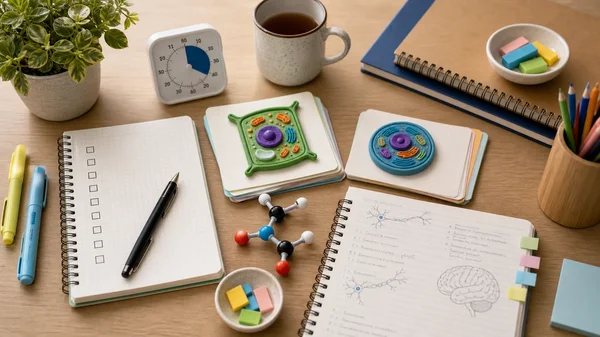
For students, the next step is to test one tactile method on one real assignment. For parents, it may be offering choices without attaching a rigid label. For educators, it may be adding short hands-on checkpoints to lessons that are otherwise mostly verbal or visual. Tactile learners often thrive when learning becomes concrete, but every learner benefits from a flexible toolkit.
FAQ
What is an example of a tactile learner?
An example of a tactile learner is a student who understands fractions better after folding paper strips, moving fraction tiles, or cutting shapes into equal parts. The hands-on action gives the learner a physical way to see and remember the concept.
What does being a tactile learner mean?
Being a tactile learner means you often prefer to learn by touching, handling, writing, building, tracing, or practicing with materials. It does not mean you can only learn one way. It means touch-based strategies may make information easier to process.
What are the 4 types of learners?
Many common models describe visual, auditory, reading/writing, and kinesthetic learners. Tactile learning is often connected with kinesthetic learning, but it focuses more specifically on touch and hands-on materials.
Is a kinesthetic learner ADHD?
No. A preference for movement or hands-on learning does not mean someone has ADHD. ADHD involves broader patterns of attention, activity, and self-regulation that should be discussed with qualified professionals when there are real concerns.
What jobs are good for tactile learners?
Tactile learners may enjoy roles with practical, hands-on problem solving, such as lab work, design, skilled trades, healthcare practice, culinary work, engineering tasks, art, physical therapy support, or technical repair. Job fit also depends on interests, training, values, and work environment.
Are most people tactile learners?
Most people use a mix of learning methods rather than one pure style. Some people strongly prefer tactile strategies, while others use them only for certain subjects. The useful goal is to find which methods help with the task in front of you.
How can I identify my learning type?
Notice which study methods help you remember and apply information. Try comparing a visual diagram, an explanation aloud, a written summary, and a tactile activity for the same topic. The pattern that consistently helps can reveal your learning preferences.