Whats Your Learning Style & Why Does It Matter?
What's Your Learning Style & Why Does It Matter?
Have you ever felt like you're spending hours studying, only to forget everything the next day? Or wondered why some subjects click instantly while others feel like an uphill battle? The answer might be simpler than you think. It lies in understanding a fundamental aspect of your personality. So, what are learning styles, anyway? They are the unique ways your brain prefers to receive, process, and retain new information. Unlocking this knowledge is the first step toward transforming your educational and professional life. Ready to discover your unique cognitive blueprint? Take our free learning style quiz and start your journey to smarter learning today.

What Are Learning Styles? A Simple Definition for Better Learning
At its core, a learning style isn't about intelligence or ability; it's about preference. Think of it like being right-handed or left-handed. You can certainly use your non-dominant hand, but your dominant hand always feels more natural and efficient. Similarly, your learning style is your brain's "dominant hand" for absorbing information. Understanding this preference allows you to choose study methods that align with your natural strengths, making learning feel less like a chore and more like a discovery.
Beyond a Buzzword: The Real Impact on Your Brain
This concept is rooted in the idea that different people have distinct neurological pathways that are more effective for learning. When you engage with material that matches your cognitive preference, you're not just making things easier. You're creating stronger neural connections. This leads to deeper understanding, better memory retention, and a significant boost in self-awareness.
Why "One-Size-Fits-All" Education Often Fails
The traditional classroom often favors one or two specific teaching methods. This can leave many students feeling left behind. If a lecture-heavy class bores you or a dense textbook makes your eyes glaze over, it's not a personal failing. It's simply a mismatch between the teaching method and your preferred learning style. Recognizing this empowers you to find strategies that truly work for you.
The 3 Core Learning Styles: Visual, Auditory, and Kinesthetic
So, what are the 3 learning styles? The VAK learning styles model is one of the most practical and widely recognized frameworks. It categorizes learners into three primary types based on their dominant sense for learning. Let's explore the three core profiles to help you answer, "what kind of learner am I?"
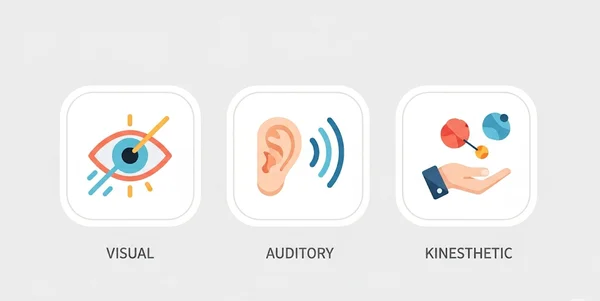
The Visual Learner: "I Need to See It to Believe It"
Visual learners thrive on what they can see. They have a strong ability to recall images, charts, and written information.
- You might be a visual learner if: You love diagrams, doodle in the margins, prefer watching a video over listening to a podcast, and use color-coding to organize your notes.
The Auditory Learner: "Sounds Like a Plan to Me"
Auditory learners absorb information best through sound. They excel in environments where they can listen to explanations and talk through ideas.
- You might be an auditory learner if: You remember song lyrics easily, enjoy group discussions, read your notes aloud to study, and prefer listening to lectures over reading textbooks.
The Kinesthetic Learner: "Let Me Get My Hands on It"
Kinesthetic, or tactile, learners need to be physically engaged. They learn by doing, moving, and touching.
- You might be a kinesthetic learner if: You get restless during long lectures, enjoy hands-on experiments, prefer to build models to understand concepts, and learn best through real-world application.
Understanding Hybrid Styles: Why You Might Be a Mix
Remember, these categories aren't rigid boxes. Most people are a combination of all three styles, with one or two being more dominant. The goal isn't to label yourself but to understand your primary tendencies. Understanding your unique mix is the first step, and our VAK model quiz can help pinpoint your dominant preference.
Why Discovering Your Learning Style Is a Game-Changer
Knowing your learning style is more than just fun trivia; it's a powerful tool for personal and academic growth. It's the key to unlocking your full learning potential.

Study Smarter, Not Harder (And Get Better Grades)
When you use study techniques tailored to your style, you stop wasting time on ineffective methods. This efficiency often leads directly to better grades and a deeper mastery of the subject matter.
Boost Your Confidence and Reduce Academic Stress
Struggling in school or work can take a toll on your confidence. Often, this struggle comes from a simple style mismatch. When you find strategies that align with your brain, you start to see success. This builds confidence and dramatically reduces the academic stress associated with learning.
Improve Communication in School, Work, and Life
Understanding your own learning style also helps you appreciate that others learn differently. This insight can improve your collaboration in group projects, your ability to train a colleague, and even your communication with family and friends. Ultimately, it's about making learning feel like a natural extension of who you are, not a challenge you have to overcome.
How to Find Your Dominant Learning Style Today
So, how do you nail down your unique profile? While you might have a hunch after reading the descriptions, the most effective way is to take a well-designed assessment.
The Quickest & Most Accurate Way: Take Our Free Learning Style Quiz
Forget lengthy, complicated tests or services that require registration. We believe this knowledge should be accessible to everyone. That's why we created a tool to help you answer the question, "how to find my learning style?" Our assessment is:
- Fast: Get your results in just a few minutes.
- Free: No fees, no subscriptions.
- No Registration Required: Your privacy is important. Get your results instantly.
- Insightful: Based on a proven educational model, our quiz gives you a clear snapshot of your VAK profile.
Take our free, 2-minute learning style quiz now!
Your Journey to Richer Learning Starts Now
Understanding your learning style is the key to unlocking a more effective, enjoyable, and rewarding educational journey. It's not about changing who you are; it's about embracing how your mind works best. By identifying whether you lean towards visual, auditory, or kinesthetic learning, you can equip yourself with the right tools to succeed.
The path to self-discovery is just one click away. Stop the guesswork and start leveraging your natural strengths today. In our upcoming articles, we’ll dive deep into specific strategies for each style. Stay tuned!
Answering Your Top Questions About Learning Styles
1. What is the most common learning style?
While research varies, many studies suggest a fairly even split, with a large percentage of the population being "hybrid" learners. The visual style is often cited as highly prevalent. The best way to know for you is to take a learning style quiz.
2. Can my learning style change over time?
Yes, absolutely. Your learning preferences can be fluid. They can change based on the subject matter, your age, and new experiences. Think of your style as a preference, not a permanent trait.
3. Is a VAK learning style quiz scientifically accurate?
A VAK quiz is a powerful self-awareness tool, not a rigid scientific diagnosis. The insights you gain can guide you toward more effective strategies. Why not test your learning style for free and see for yourself?
4. What's the difference between a learning style and a learning disability?
This is a crucial distinction. A learning style is a preference. A learning disability (like dyslexia or ADHD) is a neurological condition. Our quiz is a tool for self-discovery and educational optimization; it is not a diagnostic tool. If you suspect a learning disability, please consult a qualified medical or educational professional.